How to Draw Images in Plane Mirrors
Geometric Optics and Paradigm Formation
10 Images Formed by Airplane Mirrors
Learning Objectives
By the end of this section, you lot will exist able to:
- Describe how an image is formed by a aeroplane mirror.
- Distinguish between real and virtual images.
- Find the location and characterize the orientation of an prototype created by a plane mirror.
You only have to look as far as the nearest bathroom to find an case of an image formed by a mirror. Images in a plane mirror are the same size as the object, are located behind the mirror, and are oriented in the same management equally the object (i.due east., "upright").
To understand how this happens, consider (Effigy). Two rays emerge from indicate P, strike the mirror, and reflect into the observer's eye. Note that we use the law of reflection to construct the reflected rays. If the reflected rays are extended backward behind the mirror (see dashed lines in (Figure)), they seem to originate from betoken Q. This is where the image of point P is located. If nosotros echo this process for betoken  , we obtain its prototype at betoken
  . You should convince yourself by using basic geometry that the paradigm acme (the distance from Q to ) is the aforementioned as the object height (the distance from P to ). By forming images of all points of the object, we obtain an upright image of the object behind the mirror.
Notice that the reflected rays appear to the observer to come directly from the epitome behind the mirror. In reality, these rays come from the points on the mirror where they are reflected. The image behind the mirror is called a virtual image because information technology cannot exist projected onto a screen—the rays simply appear to originate from a mutual point behind the mirror. If you walk behind the mirror, you cannot see the image, because the rays do not get at that place. However, in front of the mirror, the rays deport exactly as if they come from behind the mirror, so that is where the virtual epitome is located.
Subsequently in this chapter, nosotros discuss real images; a real prototype can exist projected onto a screen because the rays physically get through the image. Y'all tin certainly see both real and virtual images. The difference is that a virtual image cannot be projected onto a screen, whereas a real image tin.
Locating an Image in a Aeroplane Mirror
The law of reflection tells u.s.a. that the angle of incidence is the aforementioned as the angle of reflection. Applying this to triangles PAB and QAB in (Effigy) and using bones geometry shows that they are congruent triangles. This means that the distance Pb from the object to the mirror is the same as the distance BQ from the mirror to the image. The object altitude (denoted  ) is the altitude from the mirror to the object (or, more generally, from the center of the optical chemical element that creates its epitome). Similarly, the epitome distance (denoted
  ) is the distance from the mirror to the image (or, more than more often than not, from the center of the optical element that creates it). If we mensurate distances from the mirror, and so the object and image are in opposite directions, so for a aeroplane mirror, the object and image distances should take the opposite signs:

An extended object such as the container in (Effigy) tin can exist treated as a drove of points, and nosotros can use the method to a higher place to locate the image of each point on the extended object, thus forming the extended image.
Multiple Images
If an object is situated in front of two mirrors, you may see images in both mirrors. In addition, the paradigm in the start mirror may act equally an object for the second mirror, so the second mirror may form an image of the image. If the mirrors are placed parallel to each other and the object is placed at a indicate other than the midpoint between them, then this process of image-of-an-image continues without end, as you lot may accept noticed when continuing in a hallway with mirrors on each side. This is shown in (Figure), which shows iii images produced by the blue object. Notice that each reflection reverses front end and back, just similar pulling a right-paw glove within out produces a left-mitt glove (this is why a reflection of your correct hand is a left mitt). Thus, the fronts and backs of images 1 and 2 are both inverted with respect to the object, and the front and back of image three is inverted with respect to epitome 2, which is the object for image 3.
Two parallel mirrors can produce, in theory, an infinite number of images of an object placed off center between the mirrors. Iii of these images are shown here. The forepart and dorsum of each paradigm is inverted with respect to its object. Notation that the colors are merely to identify the images. For normal mirrors, the color of an image is essentially the same equally that of its object.
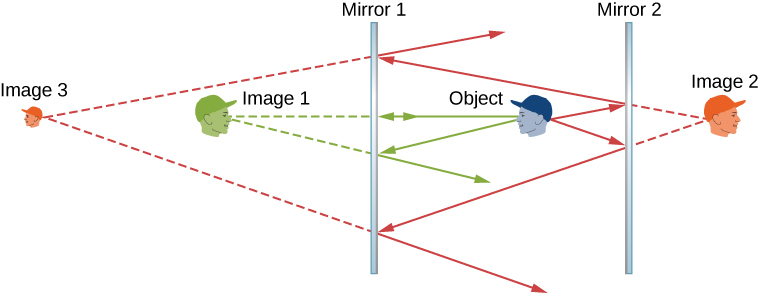
You lot may take noticed that image three is smaller than the object, whereas images one and ii are the same size every bit the object. The ratio of the prototype peak with respect to the object height is called magnification. More volition be said about magnification in the next department.
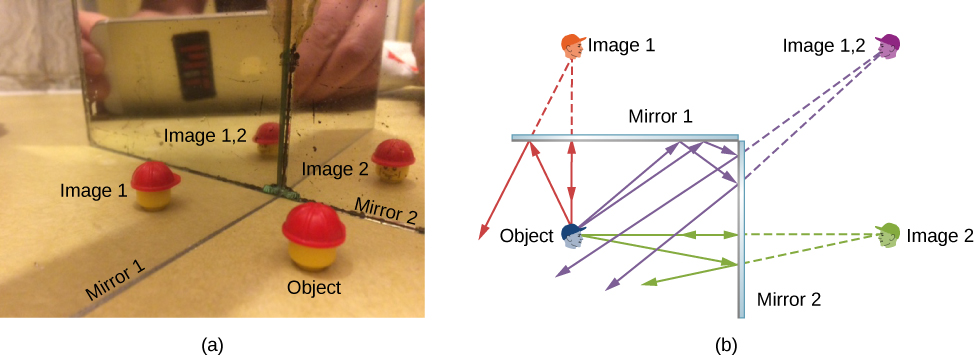
Space reflections may end. For instance, two mirrors at right angles form three images, as shown in part (a) of (Figure). Images ane and 2 result from rays that reverberate from only a single mirror, merely image 1,2 is formed by rays that reflect from both mirrors. This is shown in the ray-tracing diagram in part (b) of (Effigy). To find image 1,2, y'all have to wait backside the corner of the 2 mirrors.
Two mirrors can produce multiple images. (a) Three images of a plastic caput are visible in the two mirrors at a right bending. (b) A single object reflecting from 2 mirrors at a right bending can produce three images, every bit shown by the light-green, purple, and red images.
Summary
- A airplane mirror always forms a virtual prototype (behind the mirror).
- The paradigm and object are the aforementioned distance from a flat mirror, the paradigm size is the aforementioned as the object size, and the image is upright.
Conceptual Questions
What are the differences betwixt real and virtual images? How can yous tell (by looking) whether an image formed by a single lens or mirror is existent or virtual?
Virtual paradigm cannot be projected on a screen. You cannot distinguish a real paradigm from a virtual image just past judging from the paradigm perceived with your center.
Tin you run across a virtual epitome? Explain your response.
Tin can you lot photograph a virtual image?
Aye, you can photo a virtual image. For case, if you photo your reflection from a plane mirror, you get a photo of a virtual image. The photographic camera focuses the calorie-free that enters its lens to grade an image; whether the source of the light is a real object or a reflection from mirror (i.eastward., a virtual prototype) does not matter.
Can you project a virtual image onto a screen?
Is it necessary to project a real image onto a screen to see it?
No, yous can see the real image the same way you can see the virtual image. The retina of your eye effectively serves as a screen.
Devise an arrangement of mirrors allowing you to see the dorsum of your head. What is the minimum number of mirrors needed for this task?
If you lot wish to come across your entire body in a apartment mirror (from head to toe), how tall should the mirror be? Does its size depend upon your distance away from the mirror? Provide a sketch.
The mirror should be half your size and its meridian edge should be at the level of your optics. The size does not depend on your distance from the mirror.
Problems
Consider a pair of apartment mirrors that are positioned so that they course an bending of 120 . An object is placed on the bisector between the mirrors. Construct a ray diagram as in (Figure) to show how many images are formed.
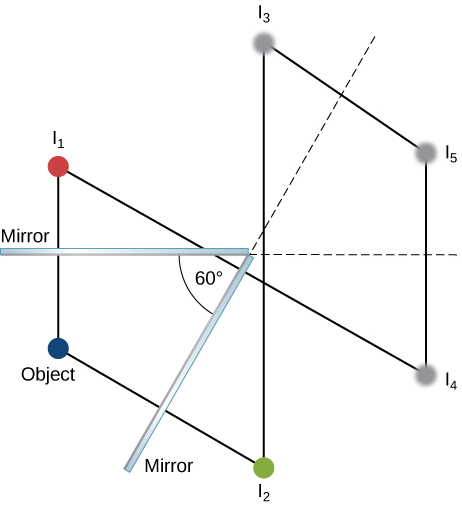
Consider a pair of flat mirrors that are positioned then that they course an angle of sixty. An object is placed on the bisector between the mirrors. Construct a ray diagram as in (Figure) to show how many images are formed.
Past using more than ane flat mirror, construct a ray diagram showing how to create an inverted paradigm.
Glossary
- plane mirror
- plane (flat) reflecting surface
- image distance
- distance of the prototype from the central axis of the optical element that produces the paradigm
- magnification
- ratio of image size to object size
- object distance
- distance of the object from the central axis of the optical chemical element that produces its image
- existent image
- image that can exist projected onto a screen because the rays physically become through the image
- virtual image
- prototype that cannot be projected on a screen considering the rays exercise not physically get through the epitome, they only appear to originate from the paradigm
Source: https://opentextbc.ca/universityphysicsv3openstax/chapter/images-formed-by-plane-mirrors/
0 Response to "How to Draw Images in Plane Mirrors"
Post a Comment